THE REQUEST
"We need to build this feature fast."
THE NEED
We need an architecture that allows fast iteration without accumulating crippling technical debt.
A product is not finished when the code ships. It is merely ready to learn. Product engineering is the discipline of creating systems that can adapt to reality.
Code is cheap. Context is expensive. The traditional linear model of building software fails because it assumes requirements are perfect. Our engineering model assumes reality is the only valid test environment.
Recognizing the gap between what is asked for and what is actually required to build a resilient system.
"We need to build this feature fast."
We need an architecture that allows fast iteration without accumulating crippling technical debt.
"Our system is too slow to change."
We need to decouple components and introduce deliberate boundaries to enable independent evolution.
"Make it scale to millions of users."
We need to identify actual bottlenecks and optimize the critical path before over-engineering the whole system.
"Rewrite the whole application."
We need a strangler pattern to incrementally modernize the system while continuing to deliver value.
"Just use the latest trendy framework."
We need technology choices based on team capability, maintenance cost, and actual problem constraints.
"Can you just copy what [Competitor] does?"
We need to solve our specific user's problem within our unique business constraints, not blindly mimic solutions to unseen problems.
THE 6-STAGE RECURSIVE LOOP
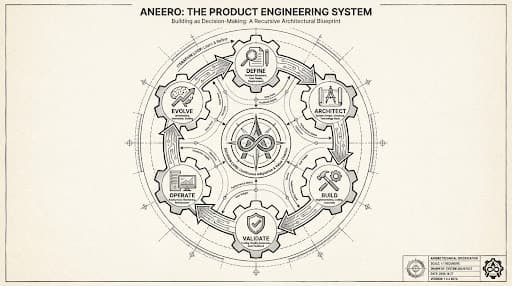
Establish the problem statement, user needs, and core requirements before writing a single line of code. We focus on identifying the 'why' to ensure the 'what' remains relevant.
Design the system logic, select the technology stack, and establish performance metrics. Architecture is the creation of options for future change.
Execute implementation, coding, and assembly with precision and structural integrity. We prioritize clean, maintainable code over short-term speed.
Rigorous testing, quality assurance, and gathering initial user feedback against defined metrics. Reality is the only valid test environment.
Deployment, active monitoring, performance tracking, and ongoing maintenance. We manage the system as it lives and breathes in production.
Optimization, iteration, and scaling based on real-world data. Every insight feeds back into the next definition phase.

Every dependency, framework, and microservice adds cognitive load and maintenance cost. We aggressively filter out unnecessary technical complexity, favoring clear, intentional architectures that map directly to the problem space.
Tangled dependencies and "resume-driven" technology choices.
Appropriate, intentional complexity that maps to business needs.
DYNAMIC DECISION SYSTEM FOR EVOLVING CONTEXTS
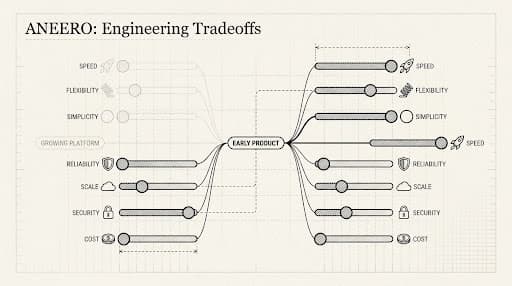
VISUALIZING THE DYNAMIC EQUILIBRIUM BETWEEN
SPEED, RELIABILITY, AND COST ACROSS THE
PRODUCT LIFECYCLE.
Connected domains focused entirely around a working product.
Responsive, accessible, and performant user interfaces built on modern web standards.
Robust APIs, data management, and core business logic designed for scalability.
Automated pipelines, cloud provisioning, and resilient hosting environments.
Pipelines, storage, and processing to turn raw data into actionable product insight.
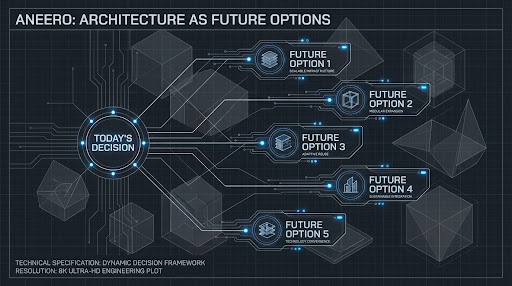
Good architecture doesn't try to predict the future; it tries to make the future less expensive. The decisions we make today are designed to maximize your ability to adapt tomorrow.
OUTCOMES OF DELIBERATE ENGINEERING
Moving beyond prototypes to production-ready systems that users can touch, feel, and break.
Technical choices that support growth without requiring constant rewriting.
Systems instrumented to provide actual data on how the product is being used.
Rapid investigation to unblock a specific decision or validate a core assumption.
Comprehensive mapping of user needs, business viability, and technical feasibility.
Deep exploration of complex, ambiguous situations to formulate a strategic response.